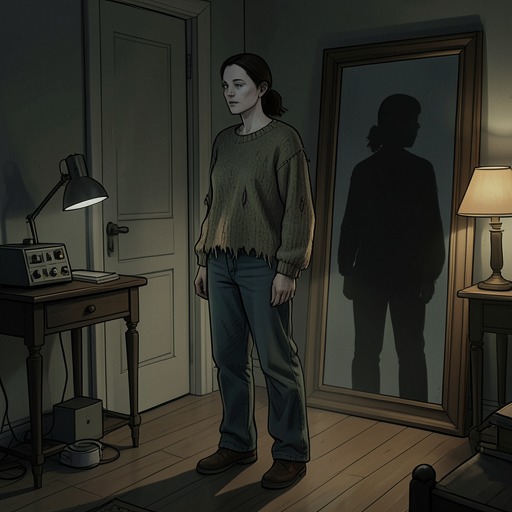
Polly Drayton’s heartbreak and despair
The GodmotherPolly Drayton’s heartbreak and despair are not a single reaction to rejection but a condition that gathers force across waiting, humiliation, and renewed pursuit. She has loved Robbie Dexter for six years and sees his cottage and disordered life as a refuge from her own constrained existence; when he does not return to her, the hope she has invested in him becomes a source of acute shame and desperation.
A life narrowed by low expectations
Polly’s heartbreak is set against the limited prospects she believes are available to her. She has three CSEs and twelve years of work at the deep-fat fryer behind her, and remains expected to help her parents run their establishment, serving tables as well as working in the kitchen. She once answered them back, but over time has grown more timid about asserting herself. Her parents are, in her view, all she has and all she can rely on, even as their demands leave little space for a life of her own.
Her mother’s maxim, “Expect nothing and you won’t be disappointed,” gives voice to a household philosophy of resignation. Polly has nevertheless expected something from Robbie. Her mother repeatedly says that Polly raised her hopes and gave herself too freely, warning that Robbie is unreliable and should be building his business instead of running after animals. Polly knows there is truth in the criticism, but it cannot settle what she feels: she loves Robbie, his crumbling cottage, and his messy life. His gratitude for her help makes her feel less like a burden than she does at home. The contrast reveals why losing him feels larger than losing a romance; he had offered a place in which she could feel valued.
Waiting for Robbie
On New Year’s Eve, Polly works downstairs while a crowded bar fills with customers and free drinks. She has sneaked upstairs for a breather and drinks two double gins bought by a retired polo player who flirts with her. She expects Robbie to arrive later, reasoning that Rachel’s black car has gone and that nobody would want to be alone on New Year’s Eve. Her flushed face sits alongside a slump that the narrative associates with a life lived without self-esteem. The party’s noise and abundance do not relieve her isolation: she waits apart from it, treating Robbie’s possible return as the evening’s real event.
Her family’s manner offers a brief, complicated counterpoint to that loneliness. Her father calls up because tables need attention and the chef is threatening to leave, but speaks gently and gives her another minute before she must come downstairs. His unexpected tenderness nearly makes Polly cry. It suggests some compassion within the family, yet does not alter the work that claims her or the dependence she feels. Later, after the bar closes, she goes outside to make sure the black car is gone. Robbie has not come, and the absence of a Christmas present adds another small, concrete measure to her sense of being forgotten.
Desperation at Station Cottage
In the frost, Polly approaches Robbie’s van and writes “I AM DYING” across its rear window with her finger. The words are a message, but also the starkest expression of how completely she experiences the loss: she does not frame her pain as a passing disappointment. She then looks toward the dark cottage, hoping its bedroom light will come on and that Robbie might somehow return with the life they shared. Nothing changes. The field is empty because the sheep have been moved into a barn for the night, leaving the frozen ground and the animals’ droppings as the immediate surroundings of her vigil.
Polly turns that setting into an act of anguished retaliation. She gathers frozen excrement with gloved hands, forces it through the letter flap at the front door, bangs on the door, counts to ten, and runs into the night. The gesture is grotesque, but it is also purposeful: unable to make Robbie answer her, she leaves a physical disturbance at his home. The episode joins wounded longing to anger without resolving either. Her despair becomes visible in a message and an action, while Robbie remains absent.
Rachel’s return and Polly’s pursuit
Later, Polly sees Robbie greet Rachel at a railway station. Rachel raises her face for a kiss; Robbie waves to her with boyish excitement, and the two leave together. Polly watches them embrace before handing over her own ticket. She tells her parents that Robbie invited her to London for a long weekend to see if they can work things out, and invents a story about staying with his sister and then at a five-star hotel. The account is presented as a lie, not evidence that Robbie has made such an invitation. Its ease shows how strongly Polly wants to preserve hope and conceal the reality from her family.
Polly has already learned where Rachel lives and works by searching Robbie’s kitchen while he is away. There she finds Rachel’s name, phone numbers, and addresses carefully fixed to the refrigerator with a sheep-shaped magnet Polly herself gave Robbie, its neck tied with a red ribbon. That discovery makes Rachel’s presence painfully tangible: the very object Polly supplied has become a fixture beside the information that connects Robbie to another woman. At the station, Robbie and Rachel do not notice Polly following them toward the buses, her half-empty rucksack bouncing behind her. Her heartbreak thus continues as pursuit rather than closure. She moves toward the couple’s London plans while still sustaining, through her story to her parents, the possibility that Robbie may return to her.